
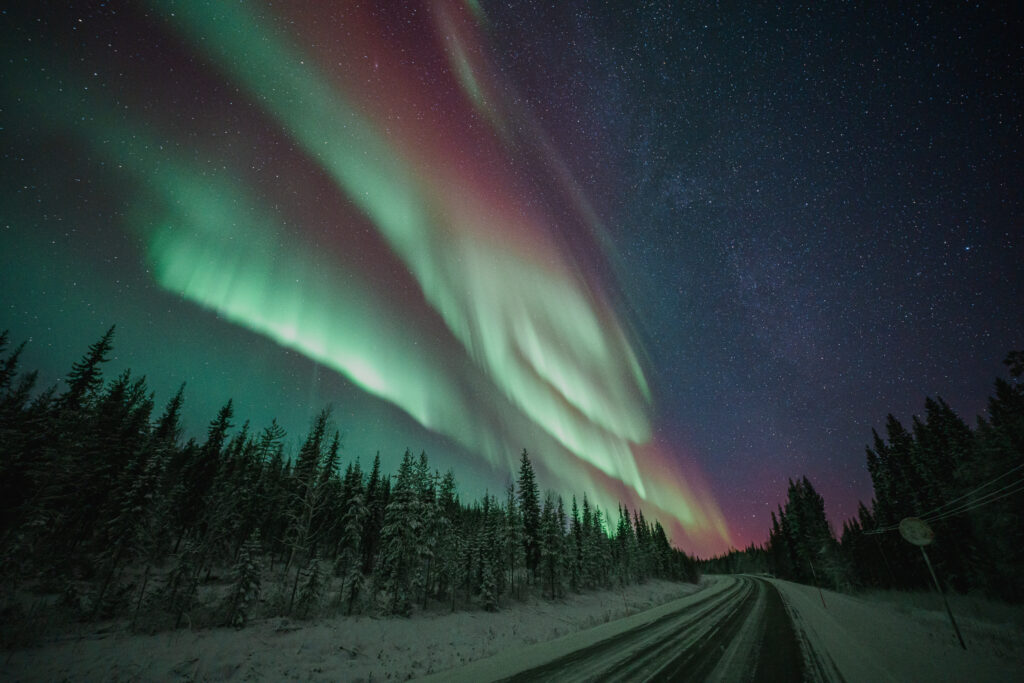
A shimmering curtain of green light unfurls across the Arctic sky, captivating all who stand beneath it. It feels like pure magic, but what is the story behind the light? What unseen forces choreograph this celestial dance, and what epic journey brings it to our world? This simple guide uncovers the cause of the northern lights, revealing the science that makes the arctic magic possible.
The journey begins not in our atmosphere, but 150 million kilometres away at the heart of our solar system. Understanding the cause of the aurora does not diminish its wonder; it deepens it. When you know the story—of a solar wind’s epic voyage, of our planet’s invisible magnetic shield, and of the atomic collisions that paint the sky—the spectacle is transformed from a beautiful mystery into a profound connection with the cosmos.
The Celestial Dance: An Introduction to the Aurora Borealis
To witness the aurora borealis is to feel the profound scale of the cosmos. It is not merely something you see; it is an experience that envelops you. Imagine a silent, emerald river flowing across the velvet canvas of the Arctic sky, a spectacle that has captivated humanity for millennia. Long before we understood the science, ancient cultures looked to the heavens and saw spirits, ancestors, or epic battles painted in light.
This celestial ballet remains as enchanting today as it was for those first stargazers. It is a quiet, powerful reminder of the intricate connection between our planet and the sun. To truly appreciate the display, one must understand the forces that bring it into being—a journey from the heart of a star to the very edge of our world. Understanding the cause does not diminish the magic; it deepens it.
A Solar Wind’s Journey: The 150-Million-Kilometre Trip to Earth
The story of the Northern Lights begins not in our atmosphere, but 150 million kilometres away, at the very heart of our solar system. Every auroral display is the final, beautiful act of an epic journey—a whisper of energy carried from the sun to our world on a cosmic current known as the solar wind. Understanding this voyage is key to appreciating the quiet spectacle above.
The Origin: A Breath from the Sun
The sun is in a constant state of flux, releasing a stream of electrically charged particles—electrons and protons—from its upper atmosphere, the corona. This is the solar wind. While usually a gentle stream, solar storms or flares can release immense bursts of this energy, sending it hurtling through space at incredible speeds. This energy travels unseen, crossing the vast emptiness between our star and our home.
Earth’s Silent Guardian: The Magnetosphere
As the solar wind approaches, it encounters Earth’s first line of defence: an invisible, protective bubble known as the magnetosphere. Generated by movements in the planet’s molten outer core, this magnetic field deflects most of the incoming particles, shielding our planet. Yet it does not block everything. In an act of celestial elegance, the magnetosphere guides a portion of these particles along its magnetic field lines, funnelling them towards the polar regions.
The Final Approach: Channelling Energy to the Poles
This funnelling action concentrates the solar particles into two vast, ring-like zones known as the auroral ovals, one shimmering above the Arctic and the other above the Antarctic. It is here, at the top of the world, that the solar wind’s long journey reaches its dramatic conclusion. The particles descend, accelerating as they approach the upper atmosphere, ready to ignite the sky.
Earth’s Magnetic Shield: The Unseen Force That Guides the Light
Our planet is shielded by an invisible guardian, a silent force field known as the magnetosphere. This is not merely a passive barrier; it is an active and elegant system that both protects life and orchestrates the celestial light show. It is the unseen guide of the aurora, capturing cosmic energy and directing it towards the polar skies.
A Planetary Defence System
Generated deep within the Earth by its molten iron core, the magnetosphere extends tens of thousands of kilometres into space. Its primary role is to deflect the constant stream of charged particles from the solar wind, which would otherwise strip away our precious atmosphere. It is the reason our world remains a vibrant, living oasis in the solar system, a testament to the powerful yet gentle forces that protect us.
The Magnetic Funnel Effect
While immensely powerful, the magnetosphere is not impenetrable. The magnetic field lines arc out from the South Pole and re-enter at the North Pole, creating natural pathways in the shield. Instead of blocking all solar particles, these lines capture a select few and guide them, funnelling them down towards the planet’s polar regions. This magnetic geometry is the fundamental reason the Northern Lights are a phenomenon of the high latitudes, a spectacle reserved for those who venture towards the Earth’s crown.
Defining the Auroral Oval
This constant, guided stream of particles creates a persistent halo of light potential around the magnetic poles, known as the auroral oval. This is the stage upon which the aurora performs. The strength of the incoming solar wind determines the size and intensity of this oval; a more energetic solar event will cause it to expand and glow more brightly, resulting in a more dramatic and widespread display for those positioned beneath it.
The Colours of the Cosmos: Why the Aurora Shines in Green and Violet
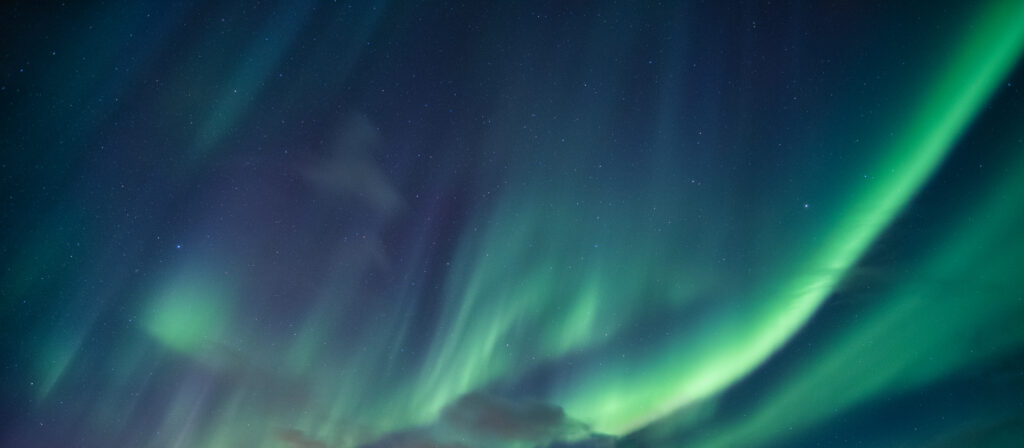
When the Northern Lights appear, they paint the sky with a palette drawn from the cosmos itself. The silent dance is rarely a single colour, but a fluid spectrum of ethereal hues. The vibrant greens, soft pinks, and deep violets are not random; each shade tells a story about a specific interaction between the sun’s energy and our planet’s atmosphere. Understanding this celestial artist’s technique only deepens the sense of wonder.
The Signature Emerald Green
The most dominant and recognised colour of the aurora is a luminous, vivid green. This signature hue is born when charged particles from the solar wind collide with oxygen atoms at altitudes between 100 and 240 kilometres. At this specific height, the oxygen atoms are excited and release their energy as green light. Our eyes are most sensitive to this part of the light spectrum, making it the most memorable and striking aspect of the display.
Hues of Rose and Crimson
Rarer and often seen during periods of intense solar activity, deep reds can appear at the highest altitudes of an auroral display, sometimes above 240 kilometres. Here, the atmospheric oxygen is less dense, and the energy exchange results in a crimson glow that can fill the entire sky. At the lower edge of the auroral curtain, collisions with nitrogen molecules can sometimes produce a fringe of pink or rose, adding a delicate border to the flowing green light.
Whispers of Blue and Violet
The most subtle colours in the auroral palette are the blues and violets. These shades are also created by interactions with nitrogen, but they occur at the very lowest edges of the display, often during the most energetic and fast-moving auroras. These colours can be difficult for the human eye to perceive against the dark sky, but they add a layer of deep, cool complexity to the cosmic light show, a final whisper of colour before the curtain fades.
From Science to Spectacle: Appreciating the Phenomenon You See
Understanding the journey of a solar particle does not diminish the spectacle; it transforms it. Knowing the celestial choreography behind the display deepens the sense of awe. When you stand beneath the Northern Lights, you are not just a spectator but a witness to the profound and beautiful connection between the Earth and its star. The science becomes a silent narrative to the visual poetry unfolding above you.
The Forms of the Celestial Dance
The aurora is not a static picture but a living, moving entity. It can begin as a soft, serene arc—a gentle bow of light stretching across the horizon. This may slowly build into the iconic rippling curtain, a shimmering drapery of green that seems to wave in a silent, cosmic breeze. On the most magnificent nights, when the display is directly overhead, it can form a radiant corona, a crown of light with rays bursting outwards from a single point in the sky, enveloping you completely in its glow.
The Conditions for a Perfect Viewing
To witness this spectacle in its full glory, three fundamental elements must align. It is a matter of preparation and position, ensuring nothing stands between you and the cosmos.
- Absolute Darkness: The aurora is a display of delicate light. To see it clearly, you must escape the glare of cities and towns. A dark, moonless night provides the perfect black canvas upon which the celestial colours can truly shine.
- A Clear Sky: The lights dance in the upper atmosphere, far above the clouds. A clear, crisp night with an unobstructed view of the stars is the first sign that a performance may be imminent. Patience is rewarded under a cloudless sky.
- The Right Location: The most crucial element is geography. The phenomenon is most reliably witnessed from within the auroral oval. In Lapland, places like Rovaniemi—home to Sky View Igloos—offer some of the darkest skies in Finland, making it one of the most reliable locations for experiencing the Northern Lights in their full splendour.


 Reach our team